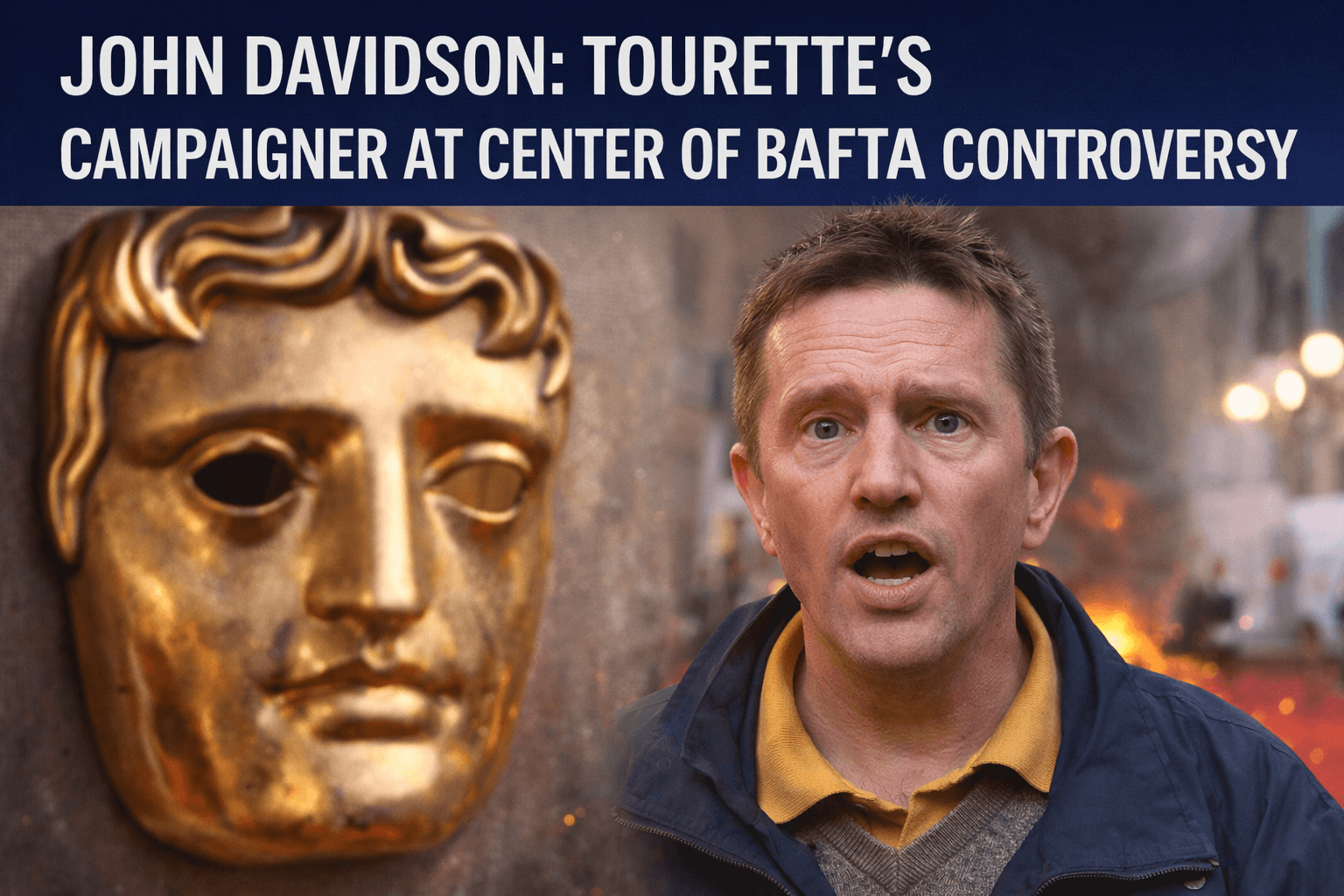
The 2026 BAFTA Film Awards will be remembered for many things: a stunning upset in the Best Actor category, six wins for one film, and the glamorous arrival of the Prince and Princess of Wales. But it is a single, jarring moment from the audience that has dominated global headlines since Sunday night: a racial slur, involuntarily shouted by Tourette’s syndrome campaigner John Davidson, that the BBC failed to edit before broadcast.
The incident has ignited a firestorm of debate about disability, race, media responsibility, and public understanding of neurological conditions and placed a 54-year-old Scottish advocate, who has dedicated his entire life to educating the world about Tourette’s, at the uncomfortable center of it all.
Who Is John Davidson?
John Davidson MBE was born in Galashiels in the Scottish Borders and began experiencing symptoms of Tourette’s syndrome around the age of 12. He was later diagnosed as a teenager at a time when the condition was almost entirely unknown to the British public.
His early life was marked by bullying, isolation, and misunderstanding. That changed in 1989 when the BBC aired a documentary called John’s Not Mad, which followed Davidson’s life and introduced millions of viewers to Tourette’s syndrome for the very first time. The film was a cultural turning point, helping shift public perception of the condition from something frightening or taboo to something worthy of compassion and understanding.
Over the decades that followed, Davidson became one of the UK’s foremost advocates for Tourette’s awareness. He delivered talks in schools and universities, worked alongside police forces, organised support camps for young people living with the condition, and campaigned tirelessly for better medical support and social inclusion. In 2019, his efforts were formally recognised when he was appointed a Member of the Order of the British Empire an MBE for services to Tourette’s awareness.
The Film That Brought Him to the BAFTAs
Davidson attended the 2026 BAFTA Film Awards as an executive producer on I Swear, a critically acclaimed biographical film about his life directed, written, and produced by Kirk Jones. The film stars Robert Aramayo best known for his role in The Lord of the Rings: The Rings of Power as a young Davidson navigating the challenges of growing up with Tourette’s in 1980s Britain.
I Swear received five BAFTA nominations, including Outstanding British Film, Best Original Screenplay, Best Supporting Actor for Peter Mullan, and Best Leading Actor for Aramayo. On the night, the film won two awards: Best Casting, and in a major upset, Best Leading Actor with Aramayo beating out heavily favoured contenders including Leonardo DiCaprio and Timothée Chalamet.
Collecting his award, Aramayo paid tribute to Davidson directly, saying: “John Davidson is the most remarkable man I ever met. He’s so forthcoming with education and he believes there should still be so much more we need to learn about Tourette’s.”
What Happened at the BAFTAs
Before the ceremony began at London’s Royal Festival Hall, the floor manager addressed the audience with a specific announcement: Davidson was in attendance, and guests should be aware they might hear involuntary noises or movements due to his Tourette’s. The audience responded with applause, a warm, welcoming gesture that Davidson later said he found deeply meaningful.
Despite the warning, nothing could fully prepare the room or the millions watching at home for what followed.
During a segment in which Sinners stars Michael B. Jordan and Delroy Lindo took to the stage to present the award for Best Visual Effects, Davidson involuntarily shouted the N-word from the audience. The moment prompted audible gasps across the hall and created an atmosphere of shock and discomfort that host Alan Cumming was left to address.
“You may have noticed some strong language in the background; this can be part of how Tourette’s syndrome shows up for some people, as the film explores that experience,” Cumming told the audience. “Thanks for your understanding and helping create a respectful space for everyone.” Other outbursts throughout the evening included involuntary shouts during speeches by BAFTA chair Sara Putt and during a Best Children’s Film acceptance speech.
Aware of the distress his tics were causing, Davidson ultimately chose to leave the auditorium early.
The BBC’s Failure and the Fallout
The controversy escalated significantly when it emerged that the BBC, which broadcast the ceremony, had failed to edit out the racial slur before airing it to viewers at home. The corporation released an apology, acknowledging that offensive language had been broadcast and that the slur was not edited out prior to transmission.
BAFTA also issued a formal statement, saying it takes full responsibility for placing its guests in a difficult situation and apologising unreservedly to Michael B. Jordan and Delroy Lindo. The organisation vowed to learn from the incident and keep inclusion at the core of everything it does.
The moment quickly went viral on social media, splitting opinion sharply. Many viewers, unfamiliar with the realities of severe Tourette’s syndrome, reacted with shock and anger. Actor Jamie Foxx drew backlash of his own after commenting online that Davidson’s outburst was unacceptable, insisting he meant it a statement widely criticised by medical professionals, disability advocates, and the broader Tourette’s community as a fundamental misunderstanding of the condition.
Davidson Speaks Out: “Deeply Mortified”
In a statement released the morning after the ceremony, Davidson addressed the controversy directly and with evident anguish.
“I wanted to thank BAFTA and everyone involved in the awards last night for their support and understanding and for inviting me to attend the broadcast,” he said. “I appreciated the announcement to the auditorium in advance of the recording, warning everyone that my tics are involuntary and are not a reflection of my personal beliefs. I was heartened by the round of applause that followed this announcement and felt welcomed and understood in an environment that would normally be impossible for me.”
He continued: “I can only add that I am and always have been deeply mortified if anyone considers my involuntary tics to be intentional or to carry any meaning. I have spent my life trying to support and empower the Tourette’s community and to teach empathy, kindness and understanding from others, and I will continue to do so.”
What Is Tourette’s Syndrome?
Tourette’s syndrome is a neurological condition characterised by sudden, repetitive, and involuntary movements and vocalisations called tics. In some cases estimated to affect around 10 to 15 percent of those with the condition it includes coprolalia: the involuntary utterance of socially inappropriate or offensive words and phrases. The condition has no cure, and tics tend to worsen in high-stress, high-stimulation environments exactly the kind of atmosphere found at a major awards ceremony.
Tourettes Action, the UK’s leading support charity, issued its own statement urging the public to understand that tics are involuntary. “We deeply understand that these words can cause hurt,” the charity said, “but it is vital that the public understands a fundamental truth about Tourette syndrome: tics are involuntary.”
Other well-known public figures who have spoken openly about living with Tourette’s include singer-songwriter Billie Eilish and Scottish musician Lewis Capaldi.
A Moment That Changed the Conversation
For all the controversy, many in the medical and disability communities are hoping the incident will serve a greater purpose forcing a global conversation about a condition that remains widely misunderstood.
John Davidson has dedicated more than four decades to exactly that mission. On Sunday night, in the most high-profile setting imaginable, his condition put Tourette’s syndrome on the front page of nearly every major news outlet in the world. Whether the reaction reflects the understanding he has fought so hard to build or reveals how far there is still to go remains to be seen.